THE IMPACT
No lost sales
Design Goal During Outages
20+
Checkout Counters Designed For
None
Card Data Stored By Design
SERVICES DELIVERED
- POS Architecture & Engineering
- Offline-First Sync Design
- Inventory Ledger & Stock Control
- Hardware Integration (scanners, scales, printers)
- UK VAT & Compliance Engineering
- Back-Office Web Application
Related Service
Supershop POS Software
At a Glance
Client: Monsoon Foods, a continental superstore and international grocery retailer in Mansfield, Nottinghamshire, England.
Project: Enterprise supershop POS and retail management platform.
Delivered from: Dhaka, Bangladesh, for a UK client.
Technology stack: Electron, React, NestJS, PostgreSQL 16, SQLite, Drizzle ORM, TypeScript (strict), pnpm monorepo.
Status: In active development. Foundations and core checkout are complete; inventory, cash management, purchasing and back-office modules are being delivered in phases.
Executive Summary
Challenge: A large-format UK supershop sits between two bad options. Light SaaS till software assumes always-on internet and a handful of registers. Legacy enterprise suites are expensive, slow to change and hard for a small in-house team to run. Monsoon Foods needed enterprise-grade reliability for money, stock and audit without an enterprise-sized project.
Solution: BengalTech designed a three-tier, offline-first platform: Electron checkout counters, an on-premise store server and a cloud HQ. The system is built around three commitments: a cashier never loses a sale, stock is never corrupted by concurrency, and every material action is explainable.
Outcome so far: A working checkout with cash and card tender, UK VAT-compliant receipts, real cashier PIN login, an offline sync outbox, and a growing back office for catalogue, stock, purchasing, promotions and reporting.
About the Client
Monsoon Foods is an established continental superstore and international grocer serving the Mansfield area, trading as a registered UK company. It runs a single large-format store with 20+ checkout counters, a backroom and its own purchasing operation, with a path to several stores under one HQ, and a small in-house team that runs its own software.
The Business Challenge
- Reliability: A queue cannot wait for the internet. The till must keep selling through network, server or hardware faults.
- Stock accuracy: Twenty counters can sell the same product in the same second. A single mutable stock counter loses updates.
- UK compliance: VAT at 20%, 5% and 0%, Challenge 25 for alcohol and tobacco, trade-approved weighing, the single-use carrier bag charge and UK GDPR all have to be correct at the till, not patched in later.
- Product variety: International grocery means loose produce sold by weight, PLU codes, price-embedded barcodes, multi-unit packs and allergen labelling.
- Accountability: Voids, refunds, price overrides and drawer opens must be gated and traceable to a person.
What We Built
Fast, forgiving checkout
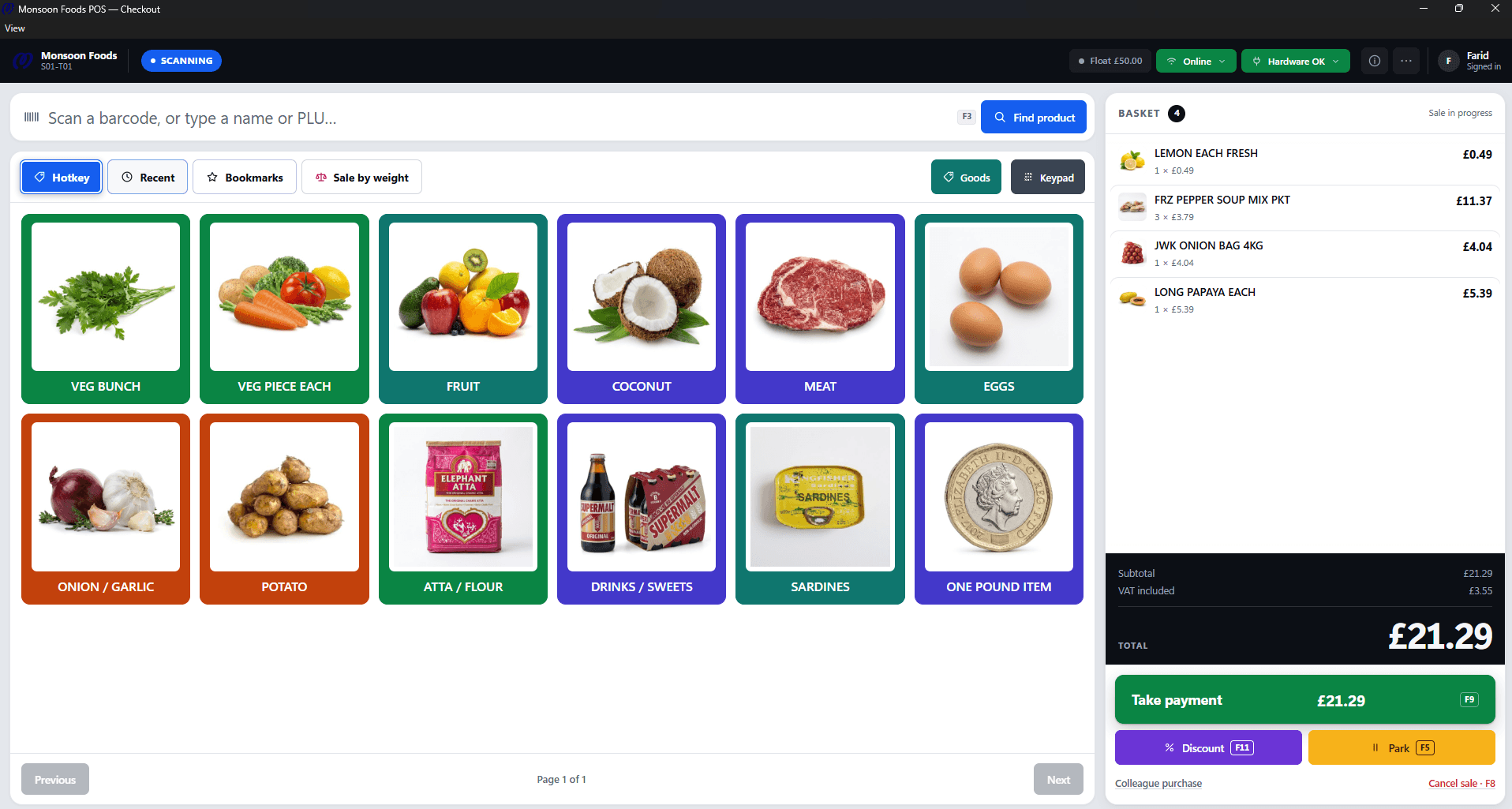
- Barcode, name and PLU search from a single field, with F-key shortcuts for payment, discount and parking a sale.
- Photo hotkey tiles for loose items such as vegetables, fruit, eggs and potatoes, colour-coded by department, so a new cashier can serve without memorising codes.
- Sale by weight, keypad entry, recent items and bookmarks.
- A live status bar for cashier, float, online state and hardware health.
- Cash and card tender, split tender, parked sales and partial-quantity refunds.
UK retail compliance
- VAT rates frozen per sale line at scan time, with a mandatory VAT summary on every receipt and the VAT registration number printed.
- Challenge 25 prompts on restricted products with cashier attestation and supervisor override recorded.
- The carrier bag charge as a first-class, auto-prompted line.
- VAT rate changes gated by a mandatory two-approver workflow.
- Retention and anonymisation rules aligned to UK GDPR.
Inventory and purchasing
- An append-only stock movement ledger with derived quantities.
- Goods receiving, supplier management, supplier price-file ingestion and stock valuation reporting.
- Unit-of-measure and pack conversion so cases, packs and singles reconcile.
Back office
- Dashboard with today against yesterday, active tills, low-stock alerts, device health and recent approvals.
- Catalogue, barcode and pricing management, promotions authoring and employee management.
- Sales search with void and refund history, cash session history and X and Z reads.
Security and audit
- Every privileged action is audited. Voids, refunds, price overrides and drawer opens pass through permission gates.
- Counter database encryption at rest and a Training mode for new staff.
Engineering Decisions That Matter to a Retailer
- Money is integer pence. No floating-point arithmetic touches a price, a VAT figure or a total.
- Sales are immutable facts with unique, time-ordered identities, so a replayed sale can never be counted twice.
- Sync is idempotent. A counter can resend the same sale safely after any failure.
- The renderer never gets device access. Hardware is reached through a controlled boundary, which limits the damage a compromised screen could do.
- No card data enters the system. Certified standalone terminals handle payment, keeping PCI scope out of the software.
Challenges Faced
Problem: Concurrent sales of the same product from different counters could race on a stock figure.
How it was solved: Stock became a derived view of an append-only movement ledger. A real race condition found during testing was reproduced, fixed and covered with an automated test.
Problem: Counters pulling changes from the store server could stall on a corrupted sync watermark.
How it was solved: We added watermark-corruption recovery to the downstream change feed and surfaced per-counter sync lag and outbox depth in Diagnostics so staff see trouble before customers do.
Lesson: In a shop, failure modes are routine. Designing the offline path first, rather than adding it later, is what makes the happy path trustworthy.
How We Work With a UK Client From Dhaka
- Documentation first. The platform is specified in 23 architecture documents and more than 200 architecture decision records, so a UK stakeholder can read and challenge every rule asynchronously.
- Tests as evidence. Money, VAT and sync logic ship with exhaustive unit tests, and a Playwright suite drives the real built Electron app, including a kill-mid-payment chaos test.
- Phased delivery. Each phase has written exit criteria, so progress is verifiable rather than reported.
- Overlap with UK hours. Dhaka is five hours ahead of the UK in winter and six in summer, which leaves a working overlap for calls while development continues in our daytime.
Delivery Progress (Not Trading Results)
- Phase 1 (foundations): complete.
- Phase 2 (core checkout): exit criteria met, including cash and card tender, receipts with VAT summary, catalogue snapshot bootstrap and PIN login.
- Phases 4, 6 and 7: inventory foundation, cash management and reporting, purchasing and back-office screens are well under way.
- Phase 8: Training mode and counter database encryption at rest are built.
We will add measured operating results here once the system trades in the store.
Why This Matters If You Are Outside Bangladesh
This is the kind of project buyers in the UK, Europe, the Gulf and North America worry about outsourcing: regulated, cash-handling, latency-sensitive and hardware-heavy. It shows we can take a foreign tax regime, foreign payment norms and an unforgiving shop-floor environment, and turn them into written requirements, tested code and an architecture the client owns.
Frequently Asked Questions
1. Can a Bangladesh-based team build software for a UK-regulated retailer?
Yes. The Monsoon Foods POS is built to UK conditions from day one: GBP in integer pence, UK VAT rates frozen per sale line, Challenge 25 prompts for age-restricted products, trade-approved scale handling, the carrier bag charge, and UK GDPR retention rules. Requirements are written down in 23 architecture documents and over 200 decision records, so the UK client can review every rule without relying on verbal hand-offs.
2. What happens to a sale if the shop internet or network goes down?
Nothing visible to the cashier. Each checkout counter keeps a local SQLite database and completes the sale against it, then stores the sale in a durable outbox and replays it idempotently once the store server is reachable again. A full trading day can run through a multi-hour outage without a lost or duplicated sale.
3. How does the system stop twenty tills corrupting stock levels?
Inventory is an append-only movement ledger rather than a number that tills overwrite. Each sale adds a movement; stock on hand is derived from the ledger. A concurrent-update race was found and fixed during development, and money and sync logic ship with exhaustive tests.
4. Does the POS handle card data?
No. The platform never stores, processes or transmits card data. Payment is delegated to certified standalone card terminals, which keeps the system out of PCI card-data scope.
5. What hardware does it support?
Barcode scanners, receipt printers, cash drawers, trade-approved weighing scales and a customer-facing display, all behind a hardware abstraction layer so drivers can be swapped or simulated in tests.
6. Is this a live production system?
Not yet, and we say so plainly. The foundations and core checkout are complete and the inventory, cash management, purchasing and back-office modules are being built phase by phase. This case study describes the delivered architecture and features, not trading results.
7. Can BengalTech build a similar POS or retail system for my business abroad?
Yes. We deliver custom POS, ERP and retail software to clients in the UK, Europe, the Gulf and North America from Dhaka. Contact us with your store format and counter count and we will scope a phased plan.
Call To Action
Running a Shop or Supermarket Abroad?
Tell us your store format, counter count and compliance needs. We will scope a phased, documented plan for an offline-first POS built to your market.
Start Your Project