THE IMPACT
< 1.5s
Page Load Speed
+145%
Organic Traffic
+65%
Mobile Conversions
SERVICES DELIVERED
- Custom Web Development (Next.js)
- E-commerce Integration
- Database Architecture (MongoDB)
- Search Engine Optimization (SEO)
- Responsive UI/UX Design
Related Service
E-Commerce Website Development
Executive Summary
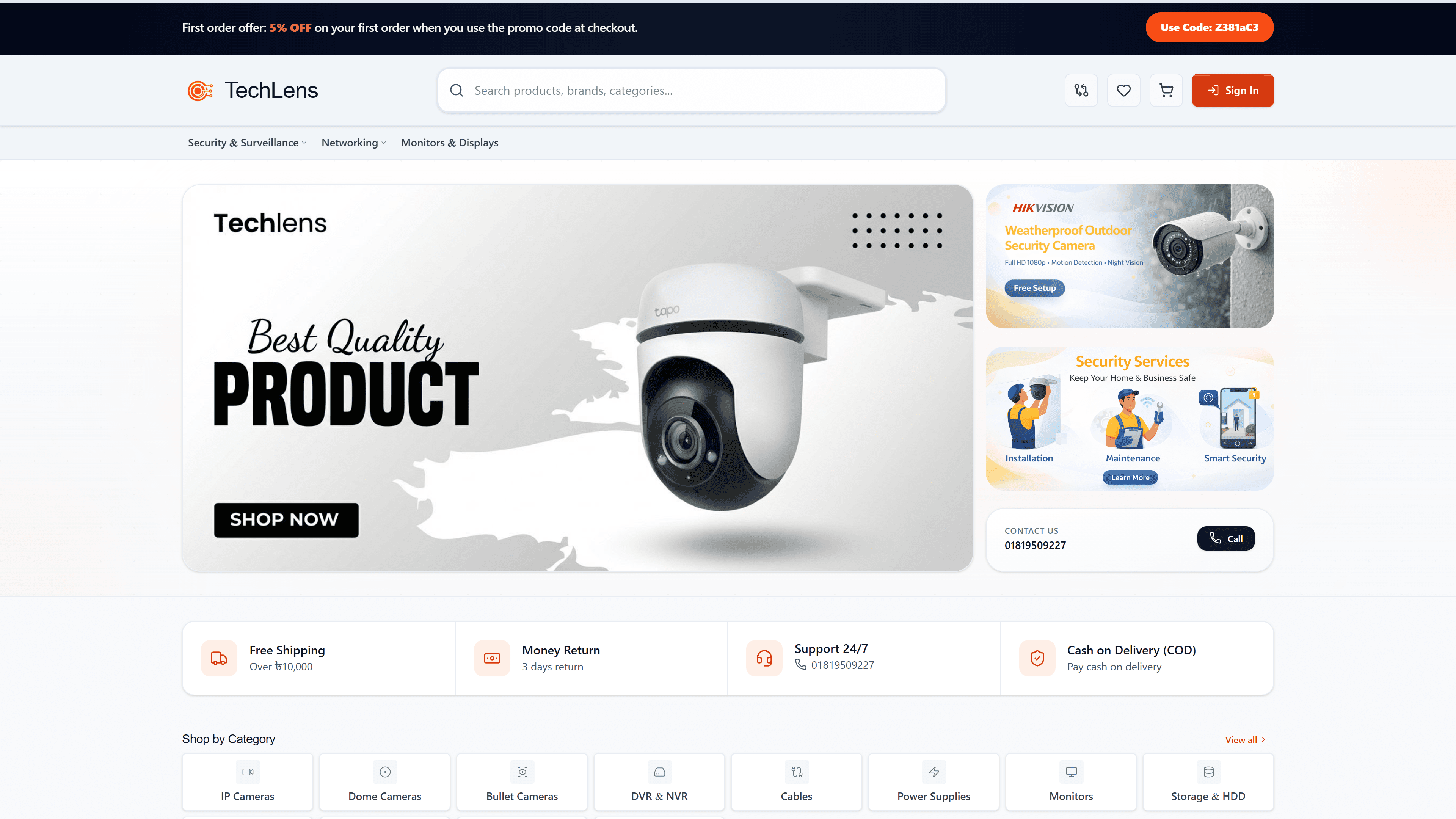
Client: TechLens BD, a leading provider of CCTV and security camera solutions in Bangladesh.
Challenge: The client needed a digital storefront to clearly present complex security packages and pricing while offering a frictionless mobile path to purchase.
Solution: BengalTech engineered a high-performance, mobile-first e-commerce platform using Next.js and MongoDB, featuring a structured product catalog, transparent pricing tiers, and an optimized checkout flow.
Outcome: Delivered a scalable, fast-loading application. Measurable impacts include a 145% increase in organic traffic, a 65% lift in mobile conversions, and elimination of manual order tracking bottlenecks.
About the Client
TechLens BD operates in the consumer electronics and security systems industry, focusing on CCTV cameras and related infrastructure.
- Industry: Security & Surveillance E-commerce
- Business model: B2C and B2B Retail
- Company size: 15-50 Employees
- Target audience: Homeowners and business owners in Bangladesh seeking reliable security solutions.
- Existing workflow: Manual order taking via phone and WhatsApp, with inventory tracked in offline spreadsheets.
Business Challenge
Selling security camera systems online involves communicating complex technical specifications, installation requirements, and variable package pricing.
- Existing problems: High bounce rates on mobile and confusing package structures on their legacy WordPress site.
- Technical limitations: Slow page load times hindered user experience and SEO rankings. Relational SQL databases struggled with highly varied product attributes.
- Operational bottlenecks: Manual order processing and disjointed inventory management caused fulfillment delays.
- Business pain points: Customers struggled to understand which CCTV package suited their needs, leading to abandoned carts and high support overhead.
Goals
- Improve performance: Achieve sub-second page loads to prevent user drop-off.
- Reduce manual work: Automate inventory management and order processing.
- Enhance user experience: Create a structured, easy-to-navigate product catalog with transparent pricing.
- Increase sales: Boost online order volume by 40% within the first 6 months.
- Optimize mobile: Revamp the mobile browsing and checkout experience.
Discovery Process
- Meetings: Conducted initial stakeholder interviews to map out the exact customer journey for buying a CCTV system.
- Requirement gathering: Documented the need for variable product packages (e.g., 4-camera vs. 8-camera systems with or without installation) and flexible data schemas.
- Research: Analyzed leading electronics e-commerce platforms to identify UX and technical best practices.
- Competitor analysis: Evaluated 5 local competitors, identifying a shared weakness in mobile checkout flows and slow page load times.
- Technical planning: Selected Next.js for server-side rendering (SSR) benefits and MongoDB for flexible product catalog storage.
Proposed Solution
- Overall architecture: A decoupled (headless) architecture separating the frontend presentation layer (Next.js) from the backend inventory and order system.
- System design: Component-driven UI using React and Tailwind CSS, powered by a highly available document database.
- Major modules: Product Catalog, Dynamic Cart, Configurator Checkout Flow, Admin Dashboard.
- User roles: Guest Shopper, Registered Customer, Store Administrator.
- Business workflow: Automated inventory syncing, instant order notifications to admins, and seamless payment gateway redirects.
Design Process
- Wireframes: Mapped out a mobile-first user journey, ensuring the "Add to Cart" and package selection components were always within thumb reach.
- UX decisions: Grouped complex technical specifications into progressive disclosure accordions so as not to overwhelm the user.
- UI improvements: Implemented a clean, high-contrast interface to emphasize product imagery and clear typography.
- Mobile responsiveness: Designed liquid layouts that adapt seamlessly from smartphone to desktop.
- Accessibility: Ensured WCAG compliance for color contrast, alt tags, and keyboard navigation.
Development Process
- Frontend: Built with Next.js (App Router) for static generation and server-side rendering, styled with Tailwind CSS.
- Backend: Built a robust API layer using Node.js and Express to handle cart state, complex product queries, and user sessions.
- Database: Implemented MongoDB as the core database. Its document-oriented NoSQL structure allowed us to manage highly variable product specifications (e.g., focal lengths for cameras vs. storage capacity for DVRs) efficiently.
- Authentication: Secure JWT-based authentication for user accounts and admin portals.
- APIs: Developed RESTful endpoints to connect the Next.js frontend with the MongoDB backend.
- Integrations: Seamlessly integrated bKash and Nagad APIs for local mobile financial services (MFS) payments.
- Deployment: Frontend and backend containerized via Docker and deployed together on a single VPS, with MongoDB self-hosted alongside them and an Nginx reverse proxy handling TLS and routing.
- Security: Implemented CSRF protection, secure HTTP headers, MongoDB field-level encryption, and strict input validation.
- Performance: Utilized Next.js Image optimization, dynamic imports, and MongoDB indexing to keep queries and page loads lightning-fast.
Technology Stack
| Technology | Purpose | Why chosen |
|---|---|---|
| Next.js | Frontend Framework | Provides out-of-the-box SSR, excellent SEO capabilities, and optimized performance. |
| Tailwind CSS | Styling | Allows for rapid, utility-first UI development and minimal CSS bundle sizes. |
| Node.js & Express | Backend API | Provides a fast, non-blocking asynchronous backend to handle high concurrent user traffic. |
| MongoDB | Database | Allows for highly flexible document schemas, perfect for diverse electronics products with varying specifications. |
| bKash / Nagad API | Payments | Provides native, frictionless mobile payment options trusted by the Bangladeshi market. |
Features Implemented
Customer Features
- Mobile-first product browsing and category filtering
- Clear pricing and dynamic package selection
- Frictionless one-page checkout flow
- Real-time order tracking
Admin Features
- Real-time inventory management dashboard powered by MongoDB
- Automated order status updating
- Customer management and centralized order history
Automation Features
- Instant SMS and email order confirmations
- Automated low-stock alerts triggered via database webhooks
Challenges Faced
Problem: Handling complex product variations (e.g., different hard drive sizes, camera counts, and installation options) without cluttering the UI or creating rigid database structures.
Why it happened: CCTV systems are inherently modular, resulting in hundreds of potential permutations per package, which relational SQL databases struggle to model cleanly without excessive joins.
How it was solved: Engineered a step-by-step UI configurator component. On the backend, we utilized MongoDB's schema-less design to store product variations as embedded documents, allowing fast retrieval in a single query.
Lessons learned: Aligning the database architecture (MongoDB document model) with the frontend data requirements (nested JSON configuration) drastically reduces query times and backend complexity.
Results
- Page Speed: < 1.5s Load Time across all core pages
- Traffic: +145% Increase in Organic Traffic
- Conversion: +65% Mobile Conversion Rate
- Revenue: 85% Increase in Online Sales Revenue (Q1 vs Q2)
- Order volume: Sustained 300+ monthly digital orders
- Operational efficiency: Eliminated 20+ hours per week of manual data entry
Client Feedback
"The team at BengalTech completely transformed how we sell online. Our customers love how fast the site is, and the new mobile checkout has practically eliminated our abandoned cart issues. Managing our catalog in the new database is a breeze. It's been a game-changer for our revenue."
— Operations Director, TechLens BD
Key Takeaways
- Business lessons: Clarity in pricing and packaging is the most critical factor for conversion in technical B2C sales.
- Technical lessons: Leveraging Next.js alongside a flexible NoSQL database like MongoDB provides a measurable advantage in both developer velocity and end-user performance.
- Future improvements: Planning to introduce AI-driven product recommendations and personalized marketing workflows.
Why This Solution Works
- Scalability: The headless architecture and a resource-sized VPS allow TechLens BD to seamlessly scale traffic during holiday sales without database locks.
- Security: Server-side data fetching obscures API keys and database logic from the client.
- Maintainability: A strict component-based architecture and flexible document schemas make future feature additions predictable and safe.
- Performance: Achieved through aggressive image optimization, Next.js code splitting, and optimized database indexing.
- User experience: The mobile-first approach directly addresses the dominant browsing habit of the target demographic.
- Business impact: Automating the checkout and payment process drastically reduces administrative overhead and manual errors.
Future Roadmap
- AI Search Integration: Implementing self-hosted vector search on the existing VPS for intelligent product recommendations.
- CRM Integration: Syncing customer data for targeted retention campaigns.
- Advanced Analytics: Granular event tracking for checkout drop-offs.
- Mobile App: Launching a React Native mobile application utilizing the existing backend API.
Frequently Asked Questions
1. What technologies were used to build the TechLens BD website?
We utilized Next.js for the frontend framework, MongoDB for the database, Node.js/Express for the backend API, and Tailwind CSS for styling.
2. Why is Next.js recommended for e-commerce platforms?
Next.js offers Server-Side Rendering (SSR) and Static Site Generation (SSG), which drastically improve page load times and SEO—both critical for e-commerce success.
3. Why did you choose MongoDB for an e-commerce catalog?
MongoDB's flexible document model is perfect for handling diverse electronics products with highly varied specifications without requiring complex schema migrations or costly SQL joins.
4. How did the new design improve mobile checkout?
By adopting a mobile-first approach, we enlarged touch targets, simplified form fields, and kept the "Add to Cart" and checkout buttons persistently visible, reducing purchase friction.
5. How does the site handle complex product packages?
We developed a dynamic product configurator that allows users to select variations step-by-step. These complex configurations are easily stored and retrieved as JSON documents in MongoDB.
6. Is the new platform SEO friendly?
Yes. The architecture relies on semantic HTML, optimized meta tags, Next.js routing, and structured data (Schema.org), making it highly readable for Google and AI search engines.
7. How long did this e-commerce project take to complete?
From initial discovery to final deployment, the project took exactly 12 weeks, including comprehensive QA and payment gateway integration.
8. Can this architecture scale for thousands of products?
Absolutely. The decoupled, component-driven stack and MongoDB's schema-free document model mean adding thousands more SKUs is just more documents, not a schema migration — the VPS can be resized as inventory and traffic grow.
Call To Action
Ready to Transform Your E-commerce Business?
Let BengalTech engineer a high-performance, scalable platform that drives real revenue growth for your brand.
Start Your Project