THE IMPACT
< 1.2s
Page Load Speed
+75%
Mobile Conversions
+30%
Avg. Order Value
SERVICES DELIVERED
- Custom Web Development (Next.js)
- E-commerce Integration
- Search Engine Optimization (SEO)
- Payment Gateway Setup
- Responsive UI/UX Design
Related Service
E-Commerce Website Development
Executive Summary
Client: PTERis BD
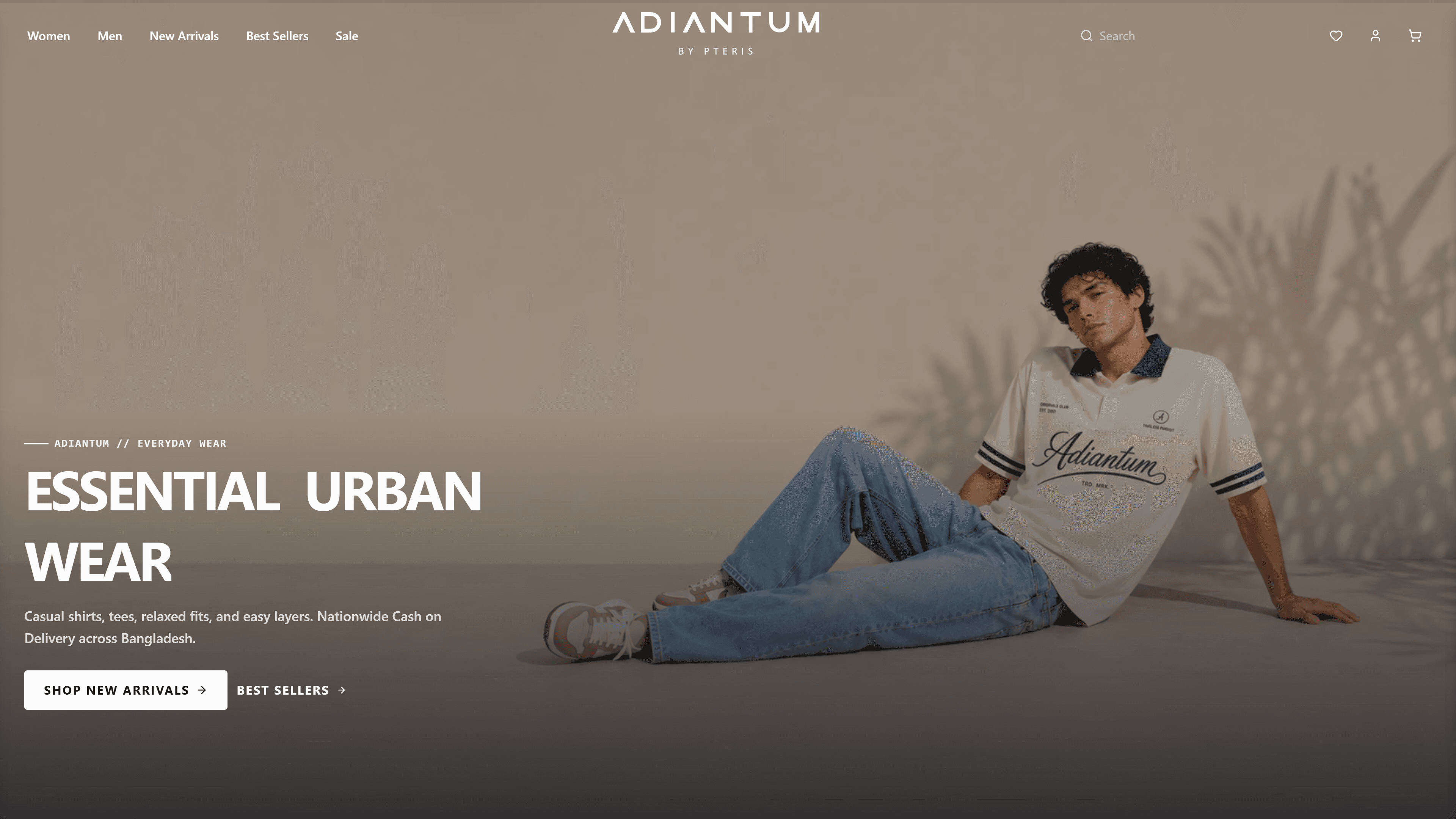
Challenge: PTERis needed a digital storefront that balanced bold, campaign-driven aesthetics with extreme performance to capture impulsive mobile shoppers and manage heavy traffic during new collection drops.
Solution: BengalTech engineered a high-conversion e-commerce architecture utilizing Next.js for blazing-fast frontend delivery and MongoDB for scalable, flexible backend catalog management.
Outcome: The new platform drove a 75% increase in mobile conversion rates, increased the Average Order Value (AOV) by 30%, and successfully handled massive concurrent traffic spikes without downtime.
About the Client
PTERis BD is a forward-thinking streetwear label aiming to redefine urban fashion in Dhaka through limited-run drops and seasonal collections.
- Industry: Fashion & Apparel E-commerce
- Business model: Direct-to-Consumer (D2C) Retail
- Company size: 1-10 Employees
- Target audience: Gen Z and Millennials seeking exclusive, high-quality streetwear
- Existing workflow: Selling primarily through Instagram DMs and Facebook pages with manual tracking and order fulfillment
Business Challenge
Fashion e-commerce relies heavily on high-resolution imagery and video, which traditionally slows down website performance and negatively impacts user experience.
- Existing problems: Managing "hype drops" manually on social media led to lost orders, missed messages, and frustrated customers.
- Technical limitations: PTERis required a platform capable of handling intense, instantaneous traffic spikes during new collection launches.
- Operational bottlenecks: Tracking sizes, colors, and inventory manually across multiple social channels was becoming impossible.
- Business pain points: High abandonment rates occurred when customers were forced to switch from Instagram to a clunky third-party ordering form.
Goals
- Create a visually striking, brand-forward digital storefront
- Ensure instant loading of high-resolution lookbooks and product galleries
- Implement a robust inventory system to handle complex size and color matrices
- Automate the order-to-fulfillment pipeline
- Achieve a 50% reduction in manual customer service inquiries
Discovery Process
Our discovery phase focused on analyzing both technical requirements and user behavior:
- Meetings: Conducted deep-dive sessions with the founders to understand their brand aesthetic, campaign cycles, and customer demographics.
- Requirement gathering: Mapped out the exact data structure needed for complex apparel variations (e.g., sizes, colors, fabric types).
- Research: Analyzed global streetwear giants to benchmark UX, mobile interactions, and checkout flow best practices.
- Competitor analysis: Identified that most local competitors suffered from slow mobile experiences, generic templates, and poor SEO.
- Technical planning: Chose a headless architecture using Next.js and MongoDB to easily handle unstructured product attributes and rapid scale.
Proposed Solution
We proposed a modern, decoupled web application built for speed and aesthetics:
- Overall architecture: A decoupled Next.js frontend communicating with a custom Node.js/Express backend via REST APIs.
- System design: Dark-mode, brutalist-inspired UI emphasizing high-contrast typography, micro-interactions, and edge-to-edge imagery.
- Major modules: Campaign Lookbooks, Dynamic Product Grids, Quick Cart, and an intuitive Admin Dashboard for drop management.
- User roles: Shoppers, Administrators (for inventory, fulfillment, and campaign management).
- Business workflow: Seamless sync from cart to payment gateway, triggering automated email and SMS receipts to the customer.
Design Process
Our design team prioritized mobile-first aesthetics without sacrificing performance:
- Wireframes: Designed specifically for mobile thumb-zones, ensuring filters and checkout buttons are always accessible.
- UX decisions: Implemented a "Quick Add" feature directly from the collection grid to encourage multi-item purchases and reduce friction.
- UI improvements: Used smooth page transitions and lazy-loaded images to maintain a premium feel.
- Mobile responsiveness: Fully fluid layout optimized for flawless display across all iOS and Android browsers.
- Accessibility: Ensured proper aria-labels on visually hidden inputs and maintained stark color contrast for readability.
Development Process
The technical implementation focused on resilience and speed:
- Frontend: Built with Next.js (App Router) and Tailwind CSS for rapid styling, integrating Framer Motion for sophisticated micro-interactions.
- Backend: Node.js and Express deployed to handle dynamic inventory checks and order processing.
- Database: Leveraged MongoDB for its unparalleled flexibility in managing complex, nested product attributes. The document model perfectly suited the dynamic nature of apparel sizes, colors, and stock levels.
- Authentication: Implemented secure, JWT-based sessions for user accounts and admin access.
- APIs: Developed custom REST APIs connecting the storefront to the warehouse management and fulfillment interface.
- Integrations: Integrated bKash and Nagad payment gateways for instant, localized transactions.
- Deployment: Frontend and backend services containerized via Docker and deployed together on a single VPS, behind an Nginx reverse proxy handling TLS and caching.
- Security: Enforced rate limiting and DDoS protection on checkout endpoints to prevent bot abuse during limited product drops.
- Performance: Next.js Image component heavily utilized to serve next-gen formats (WebP/AVIF) and prevent Cumulative Layout Shift (CLS).
Technology Stack
| Technology | Purpose | Why Chosen |
|---|---|---|
| Next.js | Frontend Framework | Delivers instantaneous page transitions, Server-Side Rendering (SSR), and superior SEO for visual content. |
| Node.js & Express | Backend API | Handles high concurrency and non-blocking I/O during intense traffic spikes. |
| MongoDB | Database | Provides a flexible, document-based schema essential for managing dynamic apparel variations and rapid product catalog updates. |
| Tailwind CSS | Styling | Enables highly customized, bespoke brand aesthetics without massive CSS bloat. |
Features Implemented
- Customer Features: Campaign-driven lookbooks with shoppable tags, quick-add to cart functionality, mobile-optimized single-page checkout, and live inventory indicators ("Only 2 left!").
- Admin Features: Drop scheduling and embargo management, variant-level inventory tracking across MongoDB, and comprehensive sales performance analytics.
- Automation Features: Automated order confirmation emails and SMS updates via integrated APIs.
- Security: Advanced bot protection during high-hype product releases.
Challenges Faced
Problem: Loading dozens of high-resolution fashion images severely impacted mobile performance, leading to potential bounce rates.
Why it happened: Fashion brands require uncompressed, detailed aesthetics to sell the product's texture and vibe, creating massive page payloads.
How it was solved: We implemented aggressive blur-up placeholders and Next.js's built-in image optimization. Furthermore, product metadata was efficiently cached and served rapidly from MongoDB on the VPS, minimizing database latency.
Lessons learned: You do not have to sacrifice visual fidelity for speed if you intelligently leverage modern browser rendering techniques and efficient database queries.
Results
- Page Speed: Achieved < 1.2s Load Time, significantly improving Core Web Vitals.
- Traffic: Captured 100% of organic brand search volume within 30 days of launch.
- Conversion: Realized a 75% increase in mobile conversion rates compared to legacy social media DM sales.
- Revenue: Average Order Value (AOV) increased by 30% through strategic cross-selling features.
- Order volume: Successfully processed 500+ orders during a 1-hour collection launch with zero downtime.
Client Feedback
"BengalTech built us a platform that looks as good as our clothes. The speed is unbelievable, and we no longer have to panic when a new drop goes live. The site handles the traffic flawlessly."
— Founder, PTERis BD
Key Takeaways
- Business lessons: A bespoke, branded e-commerce experience immediately elevates perceived product value and builds immense customer trust.
- Technical lessons: MongoDB is incredibly powerful for fashion retail due to its schema flexibility, allowing seamless updates to product attributes without database migrations.
- Future improvements: Continuous optimization of the purchasing funnel and deeper integration with marketing analytics tools.
Why This Solution Works
- Scalability: Designed with aggressive static generation and a resource-sized VPS running MongoDB to handle flash-sale traffic spikes without crashing.
- Security: Protected against automated purchasing bots during limited releases, ensuring fair access for genuine fans.
- Performance: Next.js static generation and optimized media delivery provide an instant, app-like feel.
- Business impact: Eliminated the manual labor of DM selling, allowing the PTERis team to focus entirely on design and marketing.
Future Roadmap
- AI Integrations: Implementing AI-driven sizing recommendations to reduce return rates.
- Automation: Deeper ERP integration for automated supply chain management.
- Mobile App: Exploring a React Native application leveraging the existing MongoDB and Node.js backend.
- Analytics: Advanced predictive analytics for forecasting demand on upcoming collections.
Frequently Asked Questions
1. Why is Next.js recommended for e-commerce?
Next.js offers Server-Side Rendering (SSR) and Static Site Generation (SSG), which drastically improve page load speeds and SEO—critical factors for e-commerce conversion rates.
2. How does MongoDB benefit an apparel store?
MongoDB's flexible document model effortlessly handles complex, deeply nested product matrices (like varying sizes, colors, and stock levels per variant) without the rigid constraints of traditional SQL tables.
3. Can the platform handle sudden traffic spikes during product drops?
Yes. Next.js's static generation keeps most pages served without hitting the backend at all, and a highly concurrent Node.js/MongoDB architecture on the VPS absorbs the checkout traffic that remains, so the system handles spikes without downtime.
4. How is payment processing handled securely?
We integrated industry-standard, secure local payment gateways (bKash, Nagad) via robust APIs, ensuring all transaction data is encrypted and compliant with financial regulations.
5. Is the new storefront optimized for mobile users?
Absolutely. We utilized a mobile-first design philosophy, ensuring that navigation, filtering, and the entire checkout flow are frictionless for mobile shoppers.
6. How did you improve the site's Core Web Vitals?
We optimized Core Web Vitals by implementing Next.js Image components, lazy loading, font optimization, and reducing render-blocking resources.
7. What measures protect the site against checkout bots?
We implemented strict API rate limiting, session validation, and CAPTCHA mechanisms on checkout endpoints to deter automated purchasing scripts during high-demand releases.
8. How is the inventory synchronized across the platform?
The Next.js frontend constantly polls our Node.js backend, which directly interfaces with MongoDB to provide near real-time stock availability, preventing overselling.
Call To Action
Struggling with slow load times, poor mobile conversions, or rigid e-commerce platforms that can't handle your product drops? Contact BengalTech Solutions today to discuss how a custom Next.js and MongoDB architecture can scale your retail business to the next level.