THE IMPACT
3x Faster
Booking Efficiency
+45%
Corporate Clients
-90%
Manual Errors
SERVICES DELIVERED
- Enterprise Web Application (Next.js)
- Relational Architecture (MySQL)
- Corporate Booking Funnels
- Automated Invoicing System
- Role-Based Access Control
Related Service
Web Application Development
Executive Summary
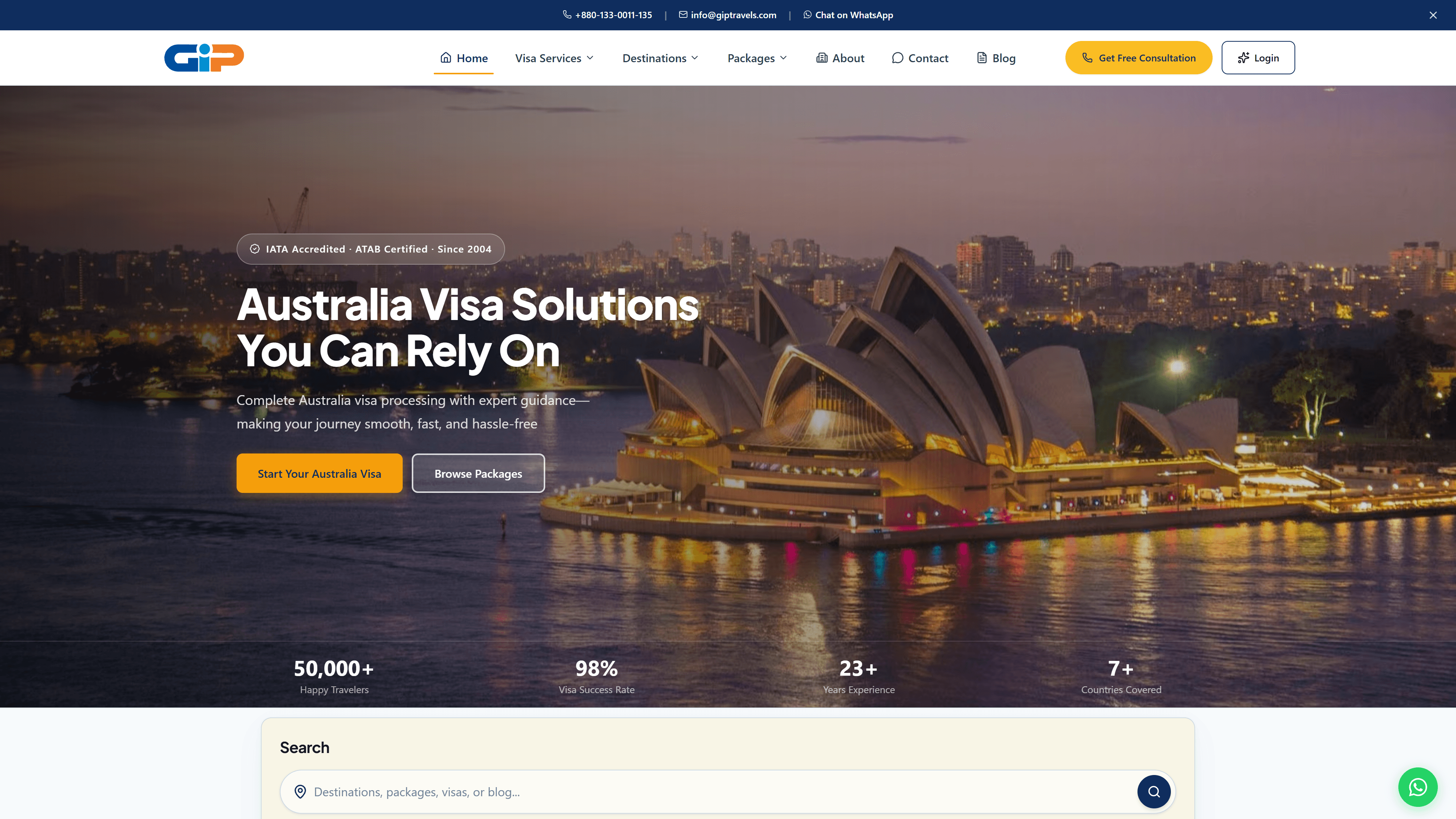
Client: GIP Travels
Challenge: Managing high-volume corporate travel requests through emails and spreadsheets led to approval bottlenecks, booking errors, and delayed invoicing.
Solution: BengalTech developed a robust B2B travel management web application powered by Next.js and MySQL, featuring role-based access, automated approval workflows, and centralized financial reporting.
Outcome: The system achieved a 3x increase in booking processing efficiency, reduced manual errors by 90%, and enabled GIP Travels to successfully onboard 45% more enterprise corporate accounts.
About the Client
GIP Travels specializes in handling large-scale corporate logistics, including flights, accommodations, and transportation for multinational companies operating in Bangladesh.
- Industry: Corporate Travel & Logistics
- Business model: B2B Services
- Company size: 50+ Employees
- Target audience: HR departments, procurement officers, and corporate executives
- Existing workflow: Email chains for approvals, PDF invoices, and offline spreadsheet reconciliation
Business Challenge
Corporate travel demands strict adherence to company policies, multi-tier approvals, and impeccable financial record-keeping.
- Existing problems: Approval delays frequently caused missed flight deals and frustrated travelers.
- Technical limitations: The lack of a unified system made it impossible to track employee travel history and departmental budgets in real-time.
- Operational bottlenecks: Invoicing corporate clients at the end of the month required days of manual spreadsheet auditing.
- Business pain points: Scaling the business was impossible without increasing headcount to manage the manual operational load.
Goals
- Automate the multi-tier corporate approval workflow.
- Reduce manual data entry and booking errors.
- Provide real-time visibility into departmental travel budgets.
- Automate monthly invoicing and reconciliation.
- Improve the overall travel booking experience for corporate employees.
Discovery Process
Our discovery phase focused on mapping the complex approval hierarchies of GIP's largest enterprise clients.
- Meetings: Conducted stakeholder interviews with GIP travel agents, corporate HR managers, and procurement officers.
- Requirement gathering: Documented the specific compliance and audit requirements for enterprise travel.
- Research: Analyzed existing enterprise travel management systems to identify UI/UX gaps.
- Technical planning: Designed a robust relational database schema in MySQL to handle complex corporate hierarchies and financial transactions.
Proposed Solution
We proposed a secure, centralized web application acting as a unified portal for both travel agents and corporate clients.
- Overall architecture: A Next.js frontend interfacing with a highly relational MySQL database via secure REST APIs.
- System design: Dashboard-first UI emphasizing data density, quick actions, and clear audit trails for financial compliance.
- Major modules: Corporate Dashboard, Multi-Tier Approval Workflows, Itinerary Builder, and Automated Invoicing.
- User roles: Travel Agents, Corporate Admins, Department Managers, and Employees.
Design Process
The design focused on providing clarity and reducing cognitive load for users processing high volumes of transactions.
- Wireframes: Created high-fidelity mockups mapping the end-to-end booking and approval journey.
- UX decisions: Implemented a split-view dashboard allowing approvers to view request details and budget impact side-by-side.
- UI improvements: Standardized data tables with advanced filtering, sorting, and bulk action capabilities.
- Accessibility: Ensured full keyboard navigability for power users (travel agents).
Development Process
- Frontend: Built with Next.js and Tailwind CSS for a responsive, performant user interface.
- Backend: Node.js API layer handling business logic and external integrations.
- Database: MySQL was utilized to enforce strict relational integrity for complex organizational structures and financial records.
- Authentication: Implemented secure JWT-based authentication with role-based access control (RBAC).
- APIs: Integrated with Global Distribution Systems (GDS) for live flight availability.
- Deployment: Configured automated CI/CD pipelines for zero-downtime deployments.
- Security: Enforced strict input validation and parameterized queries to prevent SQL injection.
Technology Stack
| Technology | Purpose | Why chosen |
|---|---|---|
| Next.js | Frontend Framework | Client-side routing and optimized data fetching for complex dashboard views. |
| Node.js | Backend API | High concurrency for handling simultaneous booking requests. |
| MySQL | Database | ACID compliance and strict relational structures are critical for enterprise financial and organizational data. |
| Tailwind CSS | Styling | Rapid UI development with consistent design tokens. |
Features Implemented
- Corporate Features: Self-service portal for employees to request travel, real-time budget tracking.
- Admin Features: Multi-tier approval workflows, corporate policy configuration.
- Automation Features: Automated notifications for pending approvals, automated generation of monthly consolidated invoices.
- Reporting: Comprehensive dashboards showing travel spend by department and cost center.
- Security: Audit logs tracking every action taken on a booking request.
Challenges Faced
Problem: Mapping complex, multi-level corporate approval hierarchies that varied significantly between different enterprise clients.
Why it happened: Enterprise organizational structures are highly dynamic, with frequent personnel changes and overlapping departmental budgets.
How it was solved: We designed a highly flexible adjacency list model in MySQL, allowing for infinite levels of hierarchy and dynamic routing of approval requests based on custom rules.
Lessons learned: Relational database design is paramount when dealing with enterprise organizational structures; NoSQL would have struggled with the recursive queries required.
Results
- Operational efficiency: 3x Faster booking processing.
- Manual work reduction: -90% reduction in booking and invoicing errors.
- Revenue: +45% increase in onboarded corporate clients due to the modernized system capabilities.
Client Feedback
"The system BengalTech built has completely transformed our operations. We can now process significantly more bookings without adding administrative overhead, and our enterprise clients love the transparency of the new portal." - Operations Director, GIP Travels
Key Takeaways
- Business lessons: Providing software as a value-add service (the client portal) is a massive competitive advantage in traditional B2B service industries.
- Technical lessons: Leveraging a relational database like MySQL is essential for building robust B2B systems that require strict financial auditing and complex hierarchical data.
Why This Solution Works
- Scalability: The system is designed to handle thousands of concurrent users and bookings.
- Security: Strict RBAC ensures users only access data relevant to their role and organization.
- Maintainability: The modular Next.js architecture allows for seamless feature updates.
- Business impact: By automating tedious manual workflows, GIP Travels can focus on expanding their client base and improving customer service.
Future Roadmap
- Mobile app: Develop a companion mobile app for travelers to manage itineraries on the go.
- AI Integrations: Implement AI to analyze travel patterns and predict future budget requirements.
- ERP Integrations: Build direct integrations with popular enterprise ERP systems (e.g., SAP, Oracle) for automated expense synchronization.
Frequently Asked Questions
1. Why is MySQL preferred for corporate booking systems?
Corporate systems require ACID compliance to guarantee that financial transactions and bookings are processed reliably. MySQL's relational integrity ensures that an employee's booking is perfectly linked to their department's budget and approval chain.
2. How does the automated approval workflow function?
The workflow dynamically routes travel requests to the appropriate manager based on the employee's department and the cost of the trip, referencing rules stored securely in the database.
3. Can the system handle multiple corporate clients with different policies?
Yes, the platform is multi-tenant, allowing each corporate client to define their specific travel policies, approval hierarchies, and budget limits.
4. How is data security managed between different companies?
We implemented strict row-level security concepts within the application logic and API layer to ensure complete data isolation between different corporate tenants.
5. Does the system integrate with existing HR software?
The architecture includes secure REST APIs designed to allow future integrations with HR systems for automated employee onboarding and offboarding.
6. How are travel budgets tracked in real-time?
Every approved booking is immediately reconciled against the assigned departmental budget in the MySQL database, providing real-time visibility on the dashboard.
7. What happens if an approver is unavailable?
The system supports delegation rules, allowing managers to temporarily assign approval rights to another team member to prevent bottlenecks.
8. How are invoices generated?
The system automatically aggregates all approved and completed travel for a specific client over a billing period and generates a consolidated, itemized invoice.
Call To Action
Ready to automate your B2B operations?
Partner with BengalTech to engineer enterprise-grade web applications that eliminate bottlenecks and scale your business.
Consult with our Enterprise Experts