THE IMPACT
500+ Users
Test Concurrency
99.9%
Uptime
+40%
Student Retention
SERVICES DELIVERED
- EdTech Application Development
- Database Architecture (PostgreSQL)
- Real-time Assessment Engine
- Payment Gateway Setup
Related Service
Web Application Development
Executive Summary
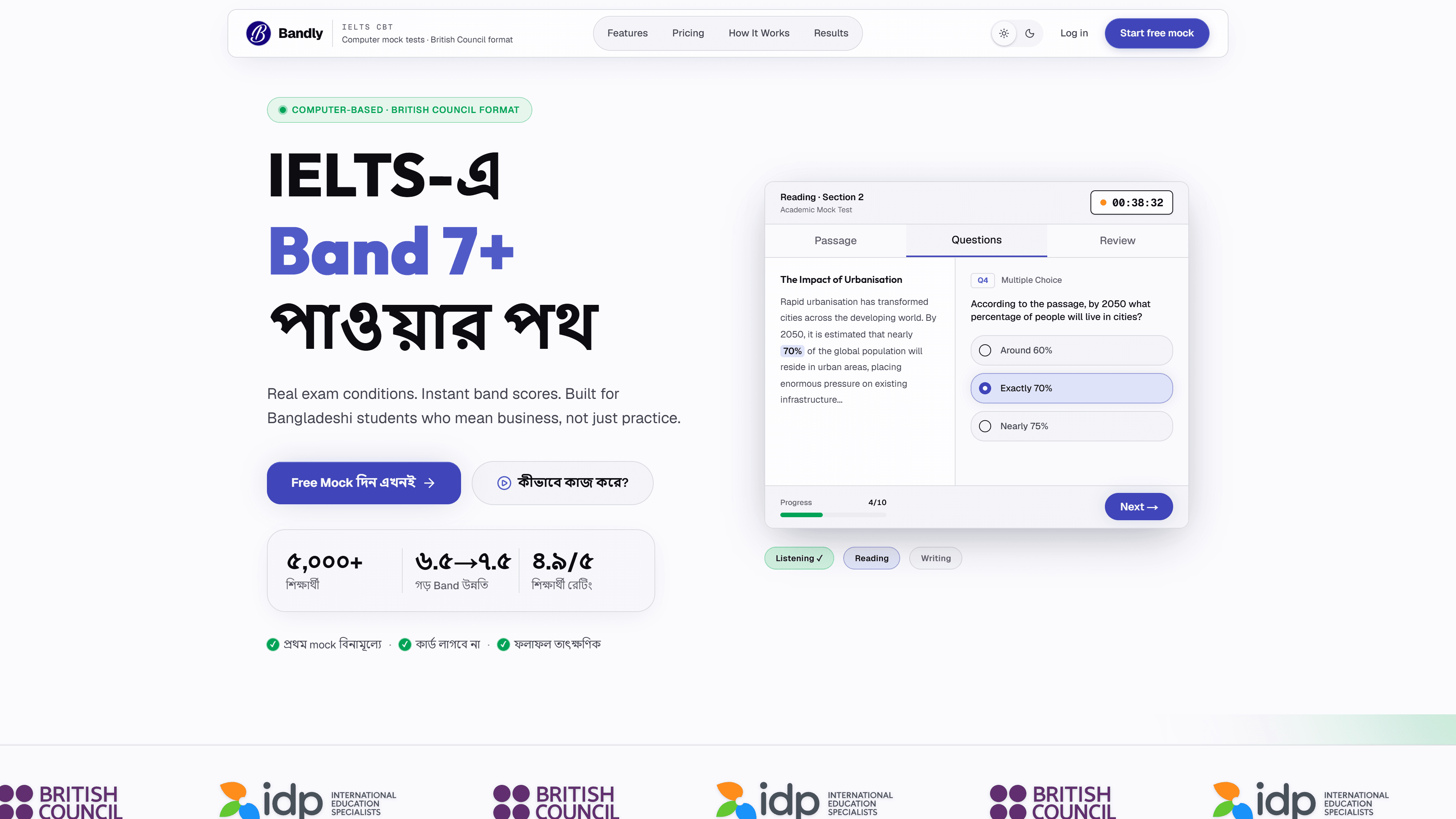
Client: Bandly BD, an innovative EdTech startup providing computer-based IELTS mock exams mirroring the official testing format.
Challenge: Simulating a high-stakes exam environment requires absolute stability, real-time auto-saving, and complex data structures capable of handling concurrent multi-module tests without data loss.
Solution: BengalTech engineered a robust assessment engine utilizing Next.js for a reactive frontend and PostgreSQL for enterprise-grade transactional database reliability.
Outcome: Scaled to support 500+ concurrent test-takers with 99.9% uptime, resulting in a 40% increase in returning students purchasing additional test bundles.
About the Client
Bandly BD is an emerging leader in the EdTech space, focused on democratizing IELTS preparation. They offer highly accurate, computer-based testing (CBT) experiences to students across Bangladesh.
- Industry: EdTech & Assessment
- Business Model: B2C SaaS / Pay-per-test
- Company Size: SME
- Target Audience: IELTS candidates preparing for computer-delivered exams.
- Existing Workflow: Previously relied on manual grading and fragmented testing tools that could not accurately replicate the true exam interface.
Business Challenge
The client faced significant technical and operational hurdles in delivering a realistic exam experience:
- Absolute Stability Required: Any crash or data loss during a 3-hour exam would destroy student trust.
- Real-time State Management: The system needed to auto-save answers every few seconds without degrading performance.
- Complex Data Relationships: Managing reading passages, listening audio tracks, writing prompts, and their respective answers required a robust relational database.
- High Concurrency: Mock test events often see hundreds of students logging in and submitting answers simultaneously.
Goals
- Replicate the exact UI/UX of the official computer-delivered IELTS exam.
- Ensure zero data loss during active testing sessions.
- Handle 500+ concurrent users smoothly.
- Automate reading and listening module scoring to reduce manual work.
- Provide deep analytics on student performance.
Discovery Process
Our discovery phase involved deep technical planning to ensure the architecture could support the stringent requirements:
- Requirement Gathering: Conducted intensive workshops with IELTS examiners to understand scoring rubrics.
- Competitor Analysis: Analyzed existing mock test platforms to identify UI/UX shortcomings.
- Technical Planning: Evaluated database solutions, ultimately selecting PostgreSQL for its unmatched ACID compliance and ability to handle complex relational schemas under high write loads.
Proposed Solution
We designed a highly resilient, real-time application architecture:
- Overall Architecture: A decoupled architecture with a Next.js frontend communicating via secure APIs to a scalable backend.
- System Design: Utilizing PostgreSQL as the single source of truth for transactional exam data, user profiles, and scoring records.
- Major Modules: Exam Simulation Engine, Automated Scoring System, Student Dashboard, Admin Content Management, and Payment Integrations.
- User Roles: Students, Examiners (for manual writing/speaking grading), and System Administrators.
Design Process
The design had one primary mandate: strict adherence to the official test layout.
- Wireframes: Mapped out the exact layout, including split-screen reading views and interactive listening components.
- UX Decisions: Implemented keyboard shortcuts, right-click highlighting, and note-taking features identical to the real exam.
- UI Improvements: Ensured high contrast and clear typography for accessibility during long reading sessions.
Development Process
The development was executed in agile sprints focusing on performance and reliability:
- Frontend: Built with Next.js and React, utilizing global state management to handle the timer and answer state without unnecessary re-renders.
- Backend: Developed a robust REST API to handle test initialization, answer submission, and grading.
- Database: Architected a normalized PostgreSQL database schema. We leveraged PostgreSQL's advanced JSONB features for flexible question structures while maintaining strict relational integrity for user sessions and scores.
- Authentication: Implemented secure JWT-based authentication.
- Deployment: Deployed on scalable cloud infrastructure with automated CI/CD pipelines.
- Security: Enforced strict parameterized queries and ORM protections against SQL injection, with encrypted data transmission.
- Performance: Optimized database queries with proper indexing to ensure sub-100ms response times for auto-save operations.
Technology Stack
| Technology | Purpose | Why chosen |
|---|---|---|
| Next.js | Frontend Application | Provides the reactivity needed for a complex, timer-based exam interface without page reloads, plus excellent SEO for marketing pages. |
| PostgreSQL | Primary Database | The most advanced open-source relational database. Essential for maintaining complex exam schemas, user answers, and high-concurrency transactional integrity with zero data loss. |
| Node.js | Backend API | Non-blocking I/O model handles thousands of concurrent auto-save requests efficiently. |
Features Implemented
- Customer Features: Realistic CBT interface, instant scoring for reading/listening, detailed performance analytics, test history.
- Admin Features: Test creation module, examiner assignment for writing tasks, user management, sales dashboard.
- Automation Features: Algorithmic grading for complex question types (e.g., matching, multiple-choice, fill-in-the-blanks).
- Payments: Secure integration with local payment gateways (bKash, SSLCommerz).
Challenges Faced
- Problem: High database load from thousands of simultaneous auto-save requests.
- Why it happened: To prevent data loss, the system saves the student's answer immediately on input change.
- How it was solved: We optimized our PostgreSQL connection pooling and implemented request debouncing on the frontend. We also utilized PostgreSQL's UPSERT capabilities to efficiently update answer records.
- Lessons learned: Database optimization and connection management are critical bottlenecks in high-concurrency real-time applications.
Results
- Test Concurrency: 500+ simultaneous users handled smoothly.
- Uptime: 99.9% availability during peak exam periods.
- Student Retention: 40% increase in returning students purchasing additional test bundles.
- Manual Work Reduction: 100% automation of reading and listening grading.
Client Feedback
"BengalTech didn't just build a website; they built an enterprise-grade testing engine. The stability of the platform under heavy load is incredible. Our students feel like they are taking the real exam, and our administrative workload has been cut in half."
Key Takeaways
- Technical Lesson: Relational databases like PostgreSQL are more than capable of handling high-frequency write operations when schema design and connection pooling are optimized properly.
- Business Lesson: Investing in absolute stability and an authentic user experience directly drives user retention and word-of-mouth growth in the EdTech sector.
Why This Solution Works
- Scalability: The decoupled architecture allows the frontend and backend to scale independently based on load.
- Reliability: PostgreSQL ensures absolute data integrity, meaning a student never loses an answer even if their internet drops momentarily.
- User Experience: The Next.js frontend provides a fluid, app-like experience that perfectly mimics the official test software.
Future Roadmap
- AI Integration: Implementing AI-based automated scoring for the writing module to provide instant, detailed feedback.
- Speaking Module: Developing a WebRTC-based interface for live examiner interviews or AI speaking assessments.
- Mobile App: Launching a companion app for vocabulary building and result tracking.
Frequently Asked Questions
1. Why use PostgreSQL instead of a NoSQL database for an exam platform?
Exams require complex, deeply related data—students, test sessions, sections, questions, and answers. PostgreSQL provides the relational integrity required to manage this complexity reliably, along with ACID compliance that guarantees zero data loss during high-stakes auto-saving.
2. How does the system handle internet disconnections during a test?
The Next.js frontend caches the state locally and automatically syncs with the PostgreSQL backend the moment the connection is restored, ensuring the timer and answers remain accurate.
3. Can the platform support thousands of concurrent users?
Yes. Through efficient API design, frontend debouncing, and optimized PostgreSQL connection pooling, the architecture is designed to scale horizontally to meet demand.
4. How is the reading and listening grading automated?
The backend contains sophisticated algorithms that compare user inputs against the correct answers stored securely in the PostgreSQL database, handling variations in spelling or formatting where appropriate.
5. Is the user interface exactly like the real IELTS exam?
Yes. We meticulously mapped the official CBT interface, ensuring features like split screens, highlighting, and navigation function identically to reduce student anxiety on test day.
6. How secure is the exam data?
Data is encrypted in transit and at rest. The PostgreSQL database is firewalled off from public access on the VPS, and strict JWT authentication prevents unauthorized access to test content or student results.
7. What happens if a student needs to resume a test later?
Because every action is transactionally saved to PostgreSQL, a student can log in from a different device and instantly resume the exam exactly where they left off, down to the second.
8. How easy is it for admins to add new mock tests?
We built a custom CMS interface that simplifies the process of uploading reading passages, listening audio files, and configuring question types, writing directly to the relational database.
Ready to Build Your EdTech Platform?
If you require a highly scalable, reliable assessment engine or complex web application, our team has the expertise to deliver. We specialize in Next.js and PostgreSQL architectures that power mission-critical platforms.
Discuss Your Project